How hard is Trenton water?
Trenton Water Works draws from the Delaware River. Its 2022 Consumer Confidence Report, covering 2021, listed hardness at 83.2 parts per million, which is about 4.9 grains per gallon. That sits in the moderately hard range on the USGS scale.
Moderately hard water leaves scale on fixtures and in water heaters but is often manageable without a full softener. Whether you want one depends on how much the scale bothers you and how your appliances are holding up.
Water hardness reported for 2021.
TWW 2022 CCR
The same figure expressed in grains per gallon.
Converted from ppm
Softener or filter, and what each does
| System | What it does | What it does not do |
|---|---|---|
| Salt-based softener | Swaps calcium and magnesium for sodium or potassium to reduce scale | Does not filter chlorine or lead. |
| Carbon filter | Reduces chlorine taste and odor | Does not soften. |
| Sediment filter | Catches grit and rust particles | Does not change hardness. |
| Reverse osmosis at one tap | Reduces many dissolved substances for drinking water | Wastes some water and treats one tap. |
| Scale inhibitor | Changes how scale forms without removing minerals | Does not soften, results vary. |
We recommend the system that matches your goal. If your goal is a certain contaminant, look for a product certified to the NSF/ANSI standard for that contaminant, and read the certification and not the box.
Considering a softener or filter? Call for an assessment.
Call (609) 547-1417What about chlorine and lead
Trenton Water Works disinfects with free chlorine and reported a 2021 residual average of 0.82 parts per million. A carbon filter can reduce chlorine taste and odor.
Lead is different. TWW says it has not exceeded the lead action level since 2018 and is replacing lead service lines. If you have a lead line, replacement is the fix, not a filter. Check your address at twwleadprogram.com. A pitcher or tap filter certified for lead reduction can be a stopgap, and TWW advises flushing taps for two to three minutes after water has sat for hours.
Source note: figures above are according to Trenton Water Works 2022 Consumer Confidence Report. TWW lead service line program.
Questions about your situation? Call the 24/7 line.
Call (609) 547-1417Installing and servicing a system
- Test. We check hardness at your tap and talk about your goals.
- Plan. Location, drain, power and bypass valves are chosen.
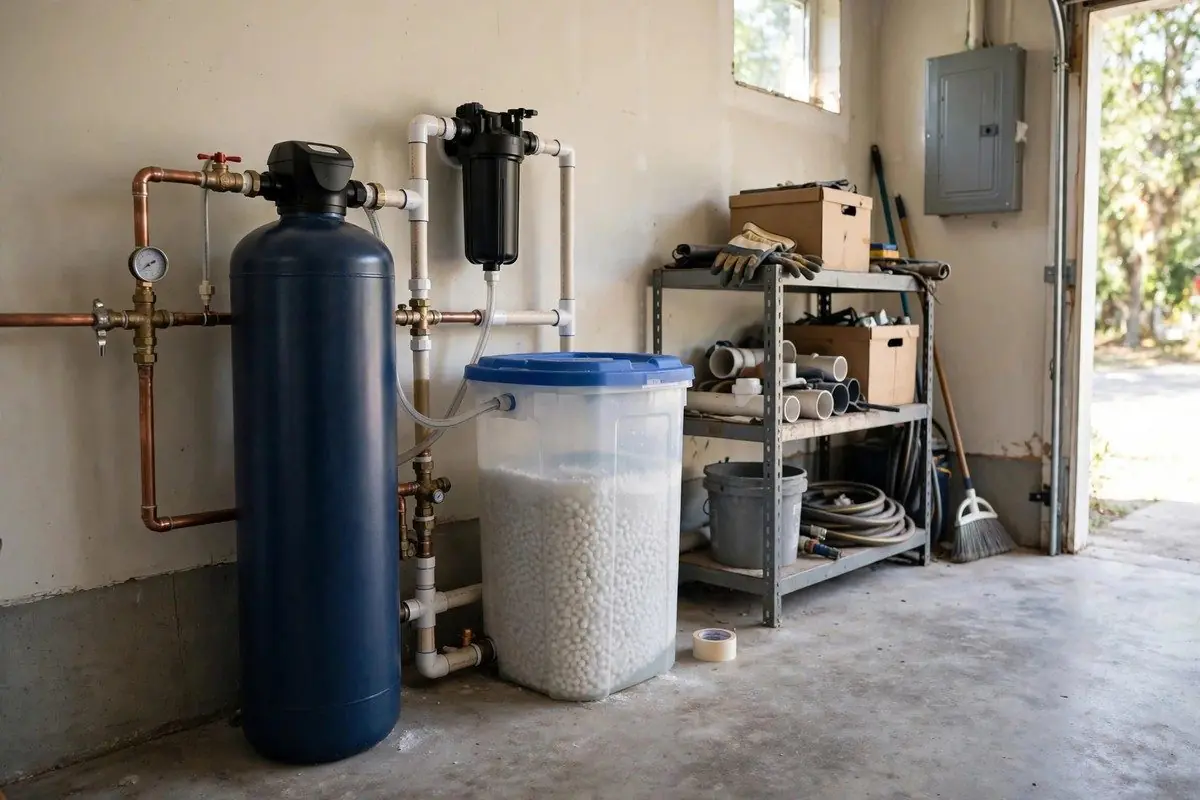
- Install. The unit is plumbed in with a bypass, a drain line and an overflow.
- Set up. Hardness and regeneration are set, and salt is explained.
Existing units also need service. A softener that stops softening may have a bad valve, a salt bridge or resin that has worn out. See water heater repair if sediment has already hurt your heater.
Does it help the water heater
Softened water reduces scale in a tank heater and in a tankless unit, which extends their life. If you own a tankless water heater, scale is its main enemy. Even so, a yearly flush is still a good habit.
Signs of hard water around your house
- White crust on faucets and showerheads.
- Cloudy glasses and spots on dishes after the dishwasher.
- Soap that does not lather well and leaves film in the tub.
- A noisy water heater and reduced hot water as sediment builds.
- Low flow from aerators and showerheads.
None of these is dangerous. They are maintenance costs. At moderately hard levels, a vinegar soak for aerators and a yearly heater flush handle most of it. A softener adds convenience and extends the life of appliances.
Salt, water and upkeep
A salt-based softener uses salt and a small amount of water each time it regenerates. You refill the salt every so often, and the unit needs an occasional check on its valve and brine tank. We explain the running cost before you decide, because it is part of the real price.
If you have a private well or a different water source, the answer changes. Trenton Water Works is a surface-water system supplied from the Delaware River, and has no wells. That is why the hardness figure above applies to TWW customers in the city.
What affects the cost
Cost depends on the system type, size, location, drain access and any plumbing changes. We do not post figures. You get a clear price before work starts. A softener also has ongoing salt and water use, which we explain.
Water softener and filtration questions
Do I need a water softener in Trenton?
TWW reported moderately hard water at 83.2 parts per million for 2021. Many homes manage without one, but scale on fixtures and in heaters is a common reason to install.
Will a softener remove lead?
No. A softener does not remove lead. Replace a lead service line, and consider a filter certified for lead as a stopgap.
Does soft water feel slippery?
Yes, many people notice a slick feel because soap rinses differently. It is normal.
Can I drink softened water?
A softener adds a small amount of sodium or potassium. If you are on a restricted diet, ask your doctor and consider an RO tap.
How often does a softener need service?
Salt is refilled regularly, and the valve and resin are checked as needed.