
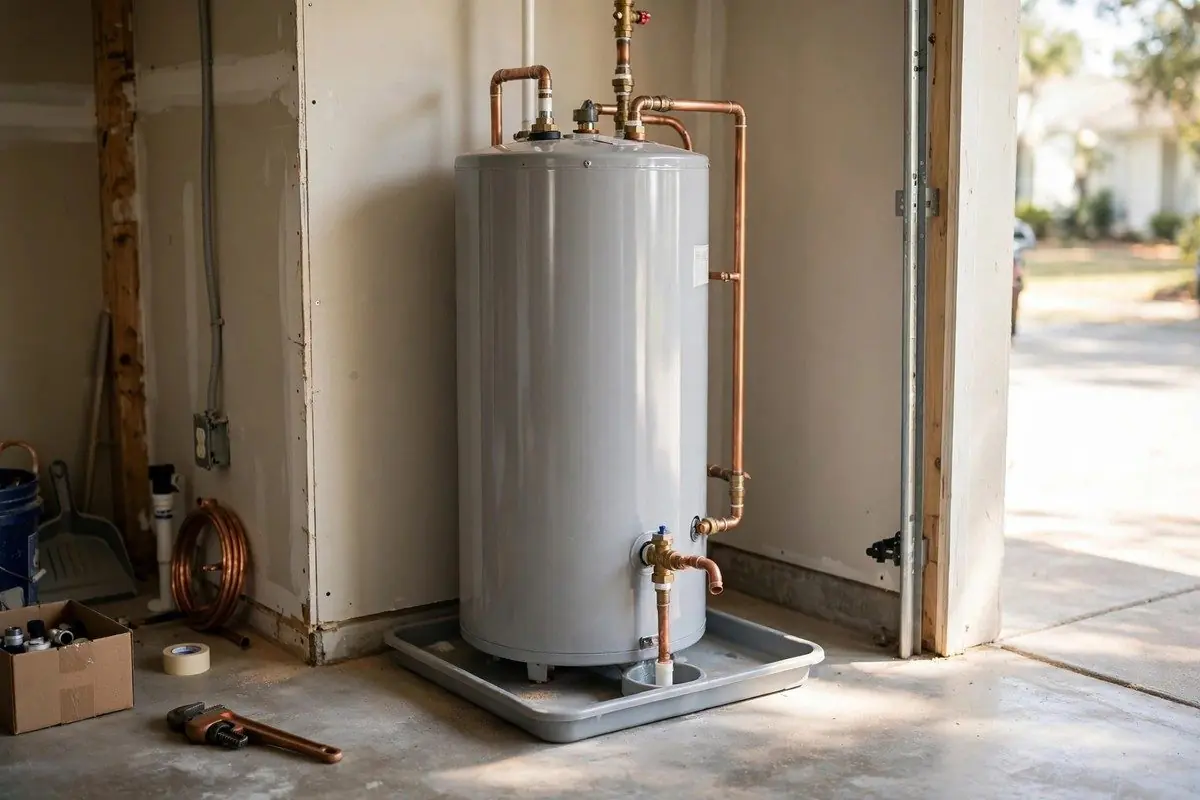
When a new installation is needed
Installation covers work beyond a straight swap. It includes new construction, an addition, a basement finish, a switch between gas and electric and moving a heater to a better location. If the heater has simply failed and the new one goes in the same spot, see water heater replacement.
- Adding a second heater for a large household or an addition.
- Moving a heater out of a flood-prone basement corner.
- Converting from electric to gas or from gas to electric.
- Installing a tankless unit where a tank used to be.
- Setting up a heater in a finished basement or a newly built unit.
Before we arrive for the installation
A little preparation makes installation day faster and keeps your home cleaner.
- Clear a path from the door to the heater location and move stored items away from it.
- Locate the main water shutoff and the gas shutoff or electric breaker for the heater.
- Take a photo of the old heater's model plate, which helps the plumber match connections.
- Plan for the water to be off for part of the day, and fill a few containers for drinking.
- Keep children and pets away from the work area.
What an installation plan covers
Before any pipe is cut, the plumber walks through the space and checks what the new unit needs.
| Item | What the plumber checks |
|---|---|
| Venting | Whether the flue path, clearance and combustion air meet the manufacturer requirements. |
| Gas supply | Line size and capacity for the new burner rating. |
| Electrical | Breaker size and wire gauge for an electric unit. |
| Water connections | Shutoffs, a pressure reducing valve if needed and an expansion tank. |
| Drain and discharge | A safe path for the relief valve discharge and a floor drain nearby. |
| Location | Access for service and protection from freezing. |
This is the work that keeps an installation safe and lets the unit last. A quick install that skips these checks causes problems later.
Questions about your situation? Call the 24/7 line.
Call (609) 547-1417Permits and inspections
Trenton plumbing permits are handled through the City's Division of Technical Services. The page lists single-trade permits as issued within 48 hours, and permit needs depend on the work. New venting, gas piping and fuel changes are the kind of job that is more likely to involve one. We ask the building department what applies and tell you.
New Jersey also uses the plumbing subcode, which adopts the National Standard Plumbing Code. In the rule text we reviewed, the 2021 edition applies. We follow the version the municipality enforces and do not guess.
Source note: facts above are according to City of Trenton inspections page, N.J.A.C. 5:23-3.15 (Cornell LII text reviewed).
Installation day
- Prepare the space. The area is cleared and the old connections are inspected.
- Set and connect. The heater is placed, connected to water, gas or electric and vented as required.
- Add safety parts. Relief valve discharge, expansion control and shutoffs are installed.
- Commission. Pressure, temperature and combustion are tested, then you are shown the shutoffs and settings.
Planning an installation? Call to book a visit.
Call (609) 547-1417What affects the installation price
The price depends on the unit, the fuel, the venting route, the permit and how much new piping is needed. A new gas line or a new circuit adds cost, and a tight attic adds labor. We do not post numbers here. We give a clear price before work starts, so you can compare before agreeing.
Questions to ask any installer
A new heater is a ten-year decision, so the questions are worth asking out loud. A good plumber answers them without hesitation.
- Is the unit sized for how my household actually uses hot water?
- Will the venting and gas line meet the manufacturer and local code requirements?
- Does the price include the permit, haul-away, the expansion tank and the relief valve discharge?
- What does the manufacturer warranty cover, and does labor have its own coverage?
- How do I shut off the water, the gas or the power if something goes wrong?
We answer those in writing as part of the plan, along with a clear price before work starts. If a quote skips them, compare it carefully.
Installing in an older Trenton home
Older houses in neighborhoods such as Mill Hill and Chambersburg may have small utility closets, old venting or a basement with a low ceiling. Those details affect which heater fits. The plumber measures before recommending.
Trenton Water Works supplies moderately hard water at 83.2 parts per million, per its 2021 data. Consider a flush plan from the start. If you want treatment, ask us about a water softener or filter when you install.
Water heater installation questions
How long does a water heater installation take?
A like-for-like unit can be finished in a visit. Changing fuel or venting takes longer. The plumber states the expected time in the plan.
Can you move my water heater to another room?
Often yes, if there is venting, a drain path and a gas or electric supply. We check the new location before quoting.
Do you remove the old water heater?
Yes. Haul-away of the old unit is included in the work.
Can I book a water heater installation quickly?
Yes. Same-day appointments are offered when a plumber is available, and planned dates are easy to set. If your current heater has failed and is leaking, see water heater repair.
Do I need an expansion tank?
If your home has a closed system, such as a backflow preventer or pressure reducing valve, an expansion tank is usually needed. The plumber checks your setup.